

If you’ve been asking yourself ‘why is my website not showing on Google’ – you’re not alone. It’s one of the most common questions we hear from Brisbane small business owners who are brilliant at what they do but completely invisible online.
You’ve put time and money into your website. Maybe you built it yourself, maybe you paid someone. Either way, you open Google, type in your business name or your service – and nothing. Or worse, your competitor shows up instead of you.
The good news: this is almost always fixable. In most cases, it comes down to one or more of seven very specific problems — and none of them require you to become a tech expert. Here’s exactly what they are, and what to do about each one.
The hard truth:
Being invisible on Google isn’t just a tech problem- it’s a revenue problem. Every day your website isn’t showing up, there are customers in your suburb searching for exactly what you offer and calling your competitor instead.
The 7 Reasons Your Website Isn’t Showing on Google
1
Your Google Business Profile is incomplete or unclaimed
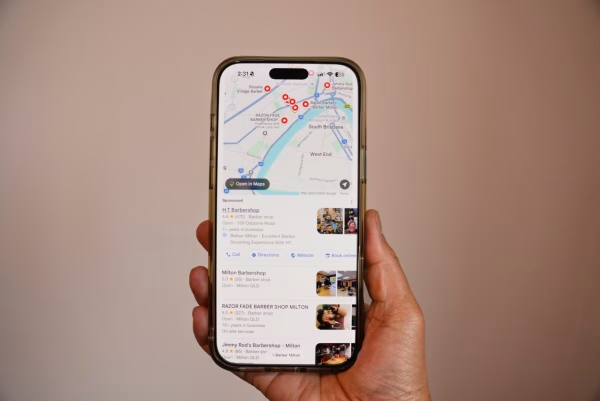
If you haven’t claimed your Google Business Profile (GBP) — or you’ve claimed it but left it half-finished — Google has very little reason to show you in local search results or on Google Maps.
When someone searches ‘bookkeeper near me’ or ‘plumber Paddington Brisbane’, Google pulls results from GBP first. No profile, or a sparse one, and you’re invisible in the most valuable real estate on the page — the Map Pack. This is the block of 3 local businesses that appears above all other search results, and it’s where most clicks go.
✓ Quick fix: Claim your GBP at business.google.com. Fill in every field — name, address, phone, hours, services, photos, and a keyword-rich description. Post an update at least once a week.
2
Your website was built on Wix, Squarespace, or a cheap template
DIY website builders are designed to look good — not to rank. They load slowly, generate messy code that Google struggles to read, and give you almost no control over the technical SEO settings that actually move the needle.
Google’s ranking algorithm rewards fast, clean, well-structured websites. A professionally built WordPress site, set up correctly from the start, will outrank a Wix site in the same suburb almost every time — even if the Wix site looks nicer on the surface. If your site is a WordPress site not appearing in Google, the issue is usually configuration rather than the platform itself.
✓ Quick fix: If you’re serious about getting found on Google, WordPress with correct SEO setup is the platform. It’s what we build on at OceanSky Digital.
3
Your website has no on-page SEO
On-page SEO is the practice of optimising each page of your website so Google knows exactly what you do, where you do it, and who you do it for. Most DIY websites — and even many professionally built ones — skip this entirely.
Without on-page SEO, Google is guessing what your page is about. With it, you’re telling Google directly: ‘This page is about web design in Toowong, Brisbane, for small business owners.’ Every page needs a keyword-rich title tag, meta description, H1 heading, and naturally placed location keywords throughout the copy.
✓ Quick fix: If you’re serious about getting found on Google, WordPress with correct SEO setup is the platform. It’s what we build on at OceanSky Digital.
4
Your website loads too slowly
Page speed is a confirmed Google ranking factor. If your website takes more than 3 seconds to load on mobile, Google is less likely to show it — and even if it does, visitors will leave before they read a single word.
Common culprits: images that weren’t compressed before uploading, no caching plugin installed, cheap shared hosting, and bloated page builder code. These are all fixable — often in an afternoon.
✓ Quick fix: Test your site at pagespeed.web.dev. Aim for 80+ on mobile. Compress images using squoosh.app (free) before uploading. Install a caching plugin like WP Super Cache or LiteSpeed Cache.
5
Your website has no local signals
Google needs to trust that your business is actually based where you say it is. It looks for local signals across your website and the wider web to verify this — and if those signals are missing or inconsistent, it won’t rank you locally.
Local signals include your NAP (Name, Address, Phone) appearing consistently on your website and GBP, your suburb mentioned naturally in your copy, a Google Maps embed on your contact page, and your business listed in local directories like True Local Brisbane.
✓ Quick fix: Make sure your business name, address, and phone number are identical everywhere — your website footer, GBP, True Local, and any other directory listing. Even a small difference (like ‘St’ vs ‘Street’) can confuse Google.
6
You have no content that answers real questions
Google’s job is to match people’s questions with the best possible answer. If your website is just a digital brochure — services, about, contact — and nothing else, you’re missing the biggest SEO opportunity available to small businesses: blog content.
Every time a potential customer types ‘how much does a website cost in Brisbane’ or ‘do I need a website if I have Facebook’, Google is looking for the best article to serve them. If you’ve written that article, you get the traffic. If you haven’t, your competitor does.
✓ Quick fix: Publish one helpful, keyword-targeted blog article per fortnight. Answer the exact questions your customers ask before they hire you. Over time, this builds topical authority that lifts every page on your site.
7
Your website is brand new- and Google needs time
If your website was launched recently, you may simply not have been indexed yet — or not long enough for Google to trust your domain. New websites start with zero authority and have to earn their place in rankings over time.
This doesn’t mean you’re helpless. There are specific strategies that accelerate visibility for new sites: fully optimising your GBP immediately, targeting hyper-local and long-tail keywords first, getting your first Google review as fast as possible, and building early backlinks through local directory listings.
✓ Quick fix: Submit your site to Google Search Console on day one. Request indexing on every important page. Target suburb-level keywords like ‘web design Milton Brisbane’ before going after broad terms like ‘web design Brisbane’.
So- What Should You Do First?
You’ve put time and money into your website. Maybe you built it yourself, maybe you paid someone. Either way, you open Google, type in your business name or your service — and nothing. Or worse, your competitor shows up instead of you.
- Claim and fully complete your Google Business Profile — this is the fastest win and costs nothing
- Run your website through Google PageSpeed Insights (pagespeed.web.dev) and note your mobile score
- Search for your business by service + suburb (e.g. ‘bookkeeper Paddington Brisbane’) — see where you actually sit
- Check that your business name, address, and phone number are identical on your website, GBP, and every directory listing
- If you’re on Wix or Squarespace and serious about ranking — have a serious conversation about switching to WordPress
If you’re not sure where your site stands, that’s exactly what our free audit is for. We look at your website, your Google Business Profile, and your current local rankings — then give you a plain-English summary of what’s working, what isn’t, and what to fix first. No jargon. No obligation. No pitch unless you ask.
Frequently Asked Questions
Why is my website not showing on Google after I just launched it?
New websites can take anywhere from a few days to a few weeks to be indexed by Google. If you’ve just launched, submit your sitemap to Google Search Console and request indexing on your key pages. Make sure your site isn’t accidentally set to ‘discourage search engines’ in your WordPress settings — this is a common mistake that makes you completely invisible.
How long does it take to show up on Google after fixing these issues?
It depends on the fix. Updating your Google Business Profile can show results within days. On-page SEO improvements typically take 4–12 weeks to reflect in rankings. Building topical authority through blog content is a 3–6 month process. The good news: every improvement compounds — the earlier you start, the faster results build.
Do I need to pay for Google Ads to show up on Google?
No. Paid ads (Google Ads) and organic SEO are completely separate. You can rank on page one of Google without spending a cent on advertising — it requires the right SEO strategy, consistent content, and time. We recommend SEO as the foundation because unlike ads, the results don’t disappear the moment you stop paying.
What is the Google Map Pack and how do I get my Brisbane business into it?
The Google Map Pack is the block of 3 local businesses Google shows at the top of local search results — above all regular website links. It’s the most valuable position in local search for Brisbane small businesses. To appear in it you need a verified and optimised Google Business Profile, consistent NAP information across the web, positive Google reviews, and strong local SEO signals on your website.
Can I do SEO myself or do I need a local SEO agency in Brisbane?
You can absolutely do some SEO yourself — especially the basics like setting up your GBP, writing location-specific page titles, and publishing helpful blog content. Where a local SEO agency adds value is in the technical SEO, keyword strategy, backlink building, and ongoing optimisation that compounds over time. Many Brisbane small business owners start by handling the basics themselves, then bring in an agency when they’re ready to accelerate.
About the authors
Murray and Jomana are the founders of OceanSky Digital– a local web design, SEO, and website maintenance agency based in Milton, Brisbane. They help small business owners across Brisbane’s Inner West get found on Google, look credible online, and keep their websites running safely. Before founding OceanSky Digital, both Murray and Jomana worked in social work — which means they bring empathy, clarity, and genuine care to every client relationship.